



Research & development
Tailor-made powder solutions
Developing advanced metal powder takes more than production capacity.
It requires a comprehensive understanding of alloy properties, atomization processes and the requirements of the final application.
Metalpine combines proprietary gas atomization technology with materials expertise and industrial manufacturing know-how. This enables the production of highly spherical metal powders tailored to specific manufacturing processes and application requirements.
Process development
- 01
Customer requirements
The development process begins with a detailed discussion of the intended application, material requirements and project objectives. Key specifications, including target chemical composition, material properties, particle size distribution and process-related requirements, are defined.
- 02
Feasibility study & process development
Based on the agreed specifications, suitable feedstock compositions and gas atomization parameters are selected. Following initial pilot-scale atomization, the powder is characterized in terms of particle size distribution, morphology, flowability and chemical composition. If necessary, additional atomization trials and powder characterization are carried out to refine the process and achieve the desired powder properties.
- 03
Industrial powder production
Once the pilot-scale powder meets the defined application requirements, the process can be transferred to industrial-scale powder production.
R&D stage
- a
Initial stage
Discussion about custom alloy composition - b
Availability stage
Check possible sources for alloy composition - c
Feasibility stage
Can it be atomized, and what needs to be considered? - d
Preparation stage
Trial production & process parameter mapping - e
Production lab stage
1–50 kg · 1st sample - f
Development loop
Possible re-entry at stage a–e
Sample sizes
| Stage | Quantity | Focus |
|---|---|---|
| Analysis sample | 0.5 kg | Powder analysis |
| Validation sample | 20 kg | Processability & first specimens |
| Evaluation sample | 100 kg | Process stability |
| Serial batch | 100–1,000 kg | Consistency |
European & national R&D projects
-
PERMANET
PERMANET aims to produce metal powder from recycled materials in a fully circular process. Additives may be introduced to adjust the chemical composition as required. Three methods are used for wire manufacturing: Conform wire, filler wire, and filament. These wires are then processed back into powder via gas atomization. All process waste is reintegrated into the system. The focus is on magnetic materials.
2024–2028
-
SICAPERMA
SICAPERMA aims to develop a dedicated process route for the production of magnetic NdFeB powder from recycled sources. The focus is on recovering material from end-of-life products such as air conditioners and hard disk drives (HDDs). Powder is produced via crucible-based gas atomization.
2024–2027
-
ADDMAG
ADDMAG aims to explore additive manufacturing of Nd-Fe-B and Fe-Cr-Co magnets following new approaches by using various base materials like amorphous powders and powders from recycled end-of-life magnets and by printing via in-situ alloying of powder mixtures. Applications will focus on magnets for electronic devices and electric motors, key sectors for these materials.
2022–2025
-
AM4PLASMA
AM4Plasma aims to advance plasma spraying technology through the development of innovative plasma torch components using multi-material additive manufacturing. The project focuses on improving thermal efficiency, extending component lifetime and expanding application possibilities. Metalpine contributes to the project through the atomization of copper- and tungsten-based filler wires to produce metal powders for additive manufacturing.
2026–2028
-
CEPAM
The CEPAM research project is developing a recycling process for high-quality metal powders for additive manufacturing. Various methods of energy input are being evaluated for energy efficiency, scalability and powder quality and implemented on a pilot scale. The recycled metal powder is characterized and processed in the Laser Powder Bed Fusion process. To compare the mechanical properties of the printed components, parts are printed from both new and recycled powder.
2024–2027
-
DIGIMATPRO4.0
The project focuses on the development of economically and environmentally optimized production processes for copper alloy powders, including Cu-Ag, for additive manufacturing. Key activities include process optimization, digital monitoring and control using sensors and machine learning, as well as the investigation of powder and component properties. Comprehensive mechanical, physical and microstructural characterization aims to improve material performance, process efficiency and resource sustainability.
2024–2027
Powder characterization
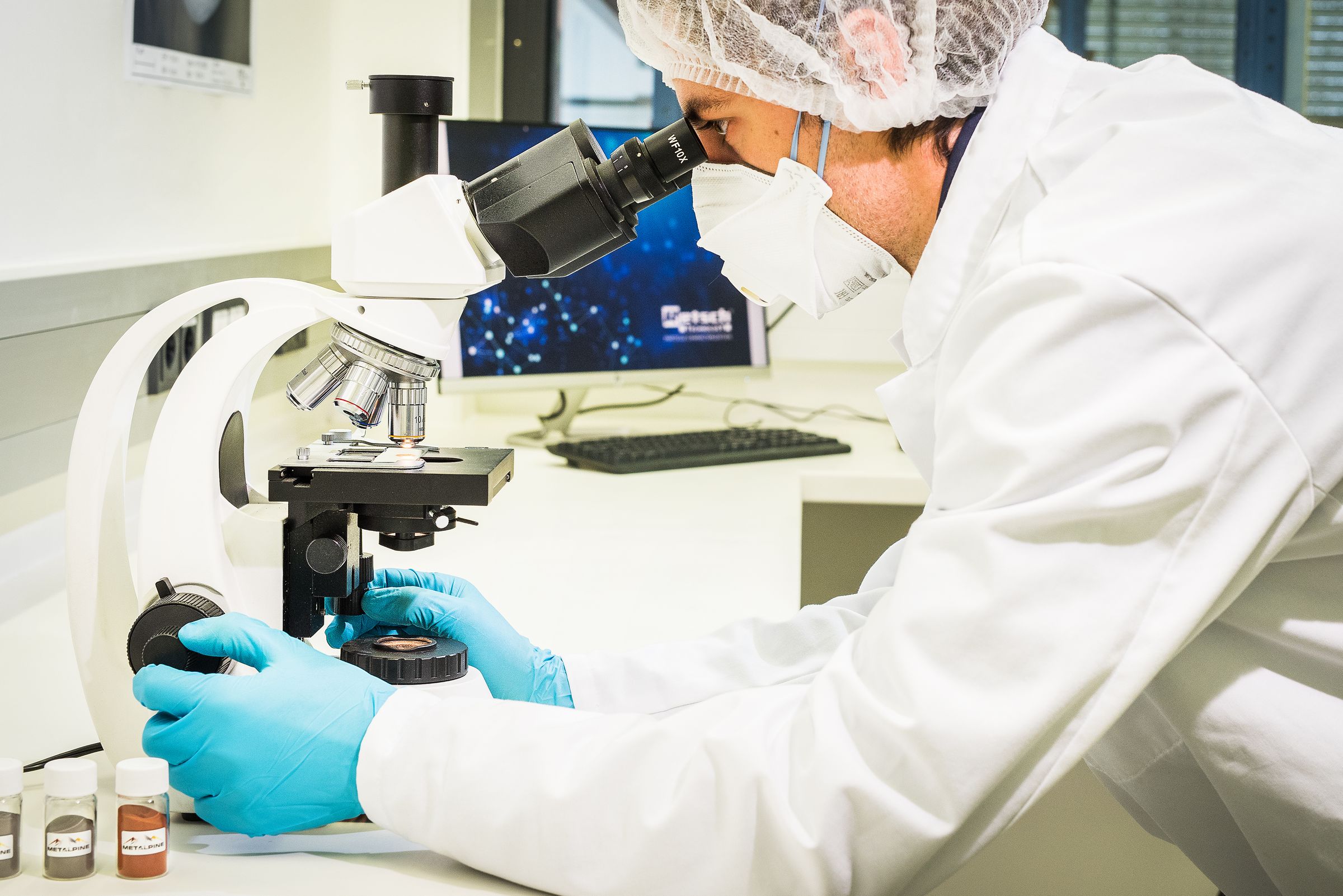
Metalpine characterizes key physical and morphological powder properties to support material development, process optimization and consistent powder quality.
- Particle size distribution
- Particle shape characteristics
- Particle morphology (SEM)
- Flowability
- Apparent density
- Tap density
- Chemical composition
- Optical microscopy
- Standardized methods