



Directed energy deposition (DED) powder
Directed energy deposition (DED) requires consistent powder flow and controlled particle size distributions to keep the material feed rate stable. We supply spherical metal powders in 45–106 µm fractions for repair, hybrid manufacturing and large components.
- LPBF-SLM
- DED (Directed Energy Deposition)
- EBM
- MIM (Metal Injection Molding)
Material families for DED
The grades below are available in narrow particle size distributions tailored to common DED systems, independent of hardware manufacturer.
| EL. | MATERIAL | GRADES |
|---|---|---|
| Cu | Copper | CuCr1Zr · CuNi2SiCr · Cu-OF · CuNi30 |
| Ni | Nickel Superalloys | IN718 · IN625 |
| Mo/Nb | Refractory Metals | MET Mo 99% · MET Nb 99% |
The Art of Spherical Powder
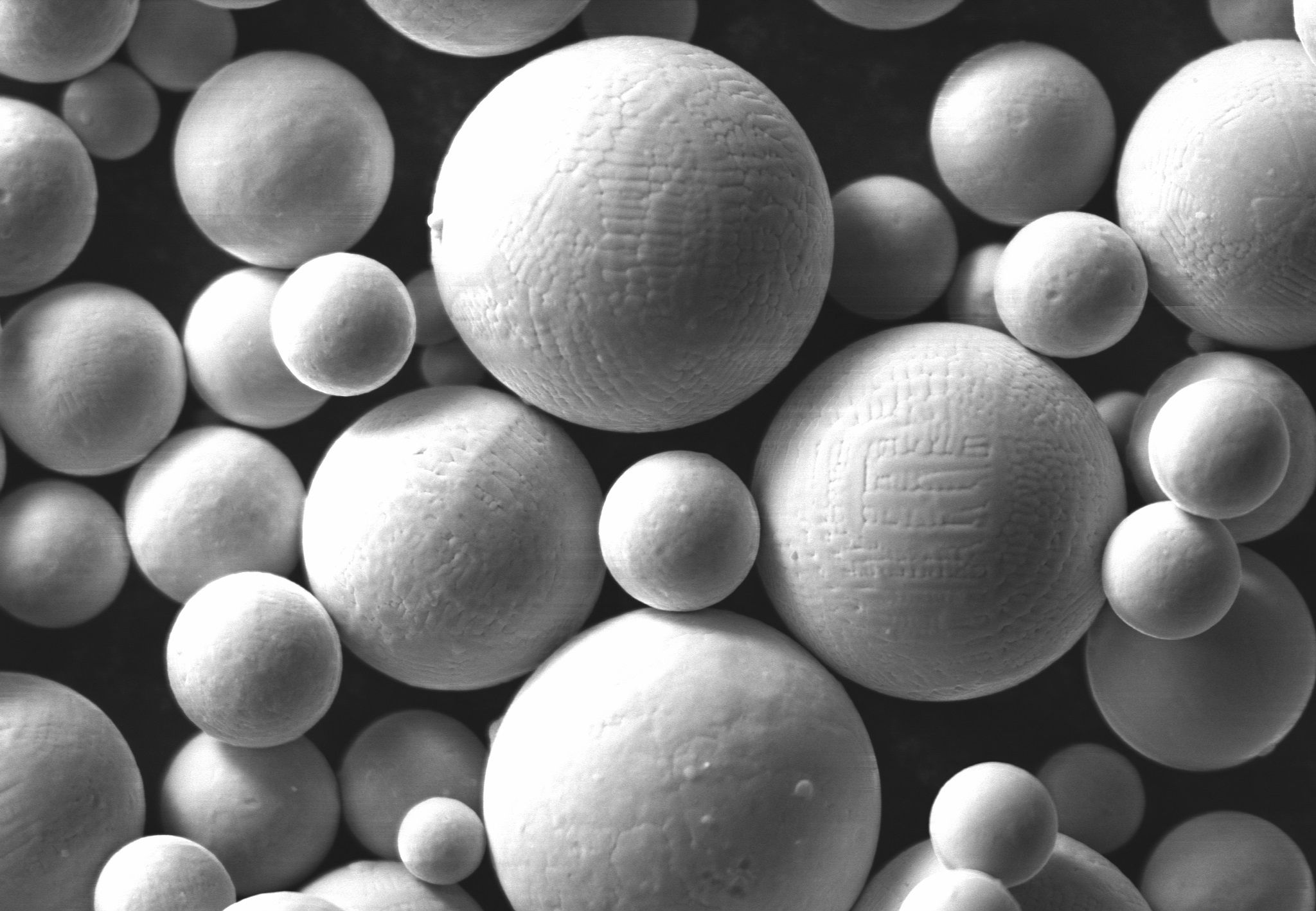
Our proprietary gas atomization process produces highly spherical, 0% porosity powder under argon in a dust-free environment. We operate a quality management system certified to ISO 9001 and EN 9100.
Frequently asked questions
Which fraction suits our DED system?
We offer the 15–53 µm and 45–106 µm fractions for DED. It has a minimum D10 of 40 µm and a maximum D90 of 106 µm.
Is DED powder the same as LPBF powder?
The alloy can be the same, but the fraction is not. Our LPBF fractions, such as 15–45 µm and 20–63 µm, are finer than our coarse DED fraction of 45–106 µm; for DED we also offer 15–53 µm.
Can you produce a custom fraction or process our own material?
Yes. Other particle size distributions are available on request. For powder you already have, we can screen it at grain sizes from 10 to 1,000 µm or classify it to a narrower distribution. We can also atomize metal or alloy feedstock that you supply.
Can we order other alloys in DED fractions?
Yes. Every grade in our portfolio can be produced in our DED fractions. That includes our stainless steels, such as 316L, and our titanium alloys, such as Ti-6Al-4V. Other materials are available on request.
Why do particle shape and satellites matter in DED?
In powder-fed DED, a carrier gas transports the powder from the feeder to the melt pool, so regular deposition requires steady powder flow. Flowability depends on particle shape and on the amount of satellites, which are smaller particles that adhere to larger ones. Our powders have a sphericity SPHT3 above 0.90 and a low satellite content.
Why does porosity inside the powder matter?
Gas trapped inside powder particles can be carried into the melt pool and form pores in the deposit. Our powders have 0% porosity, so they do not carry this gas into the melt pool. Our technical datasheets include microsection images of the particles. Porosity in the deposit also depends on your process parameters.
How do you verify particle size distribution?
Our in-house laboratory measures particle size distribution by dynamic image analysis according to ISO 13322-2; laser diffraction according to ASTM B822 is available on request. Dynamic image analysis also captures particle shape, which is how we determine sphericity.
How do you measure flowability?
We measure flow rate with a Hall flowmeter according to ASTM B213. The test records the time 50 g of powder takes to pass through a calibrated funnel. For more complex flow behavior, ring shear tests can be carried out by our university partners.
Can we use your powder on any DED system?
Our powders are not tied to a hardware manufacturer. Powder feeding also depends on settings such as feeder speed and carrier gas flow, so we recommend testing a sample on your own equipment before production. A sample certificate based on previous production campaigns is available for your quality review.
Do you supply quantities for large DED builds?
Yes. Unit sizes range from 100 g up to approximately 500 kg, with 5, 10, and 20 kg units as standard. Powder in stock is typically ready to ship in about 3–5 business days. New production usually takes 3–12 weeks, depending on our current backlog and confirmation from our raw material supplier.
Are your powders subject to export controls?
Yes. Nickel, molybdenum, niobium, and titanium are among the materials that require dual-use export approval before they ship outside the EU. A license requirement can also arise from the destination and intended use. For these powders, we need a completed end-user certificate with every order and for each material, although exceptions can be evaluated.
What does your DED process require?
We can help you select the powder properties that best suit your system and processing method.