



Laser powder bed fusion (LPBF) powder
LPBF – also known as selective laser melting (SLM) – builds parts layer by layer from a powder bed, so every layer must be applied uniformly. We supply low-satellite, highly spherical fractions of 15–45, 15–53 and 20–63 µm, documented for every batch.
LPBF places high demands on powder sphericity, flowability, and consistency. It’s necessary to apply each layer uniformly to support stable production and repeatable part quality. Metalpine supplies low-satellite powder fractions optimized for LPBF processes, with documented powder characteristics. Standard fractions are 15–45, 15–53 and 20–63 µm (possible range 10–90 µm); other PSDs on request.
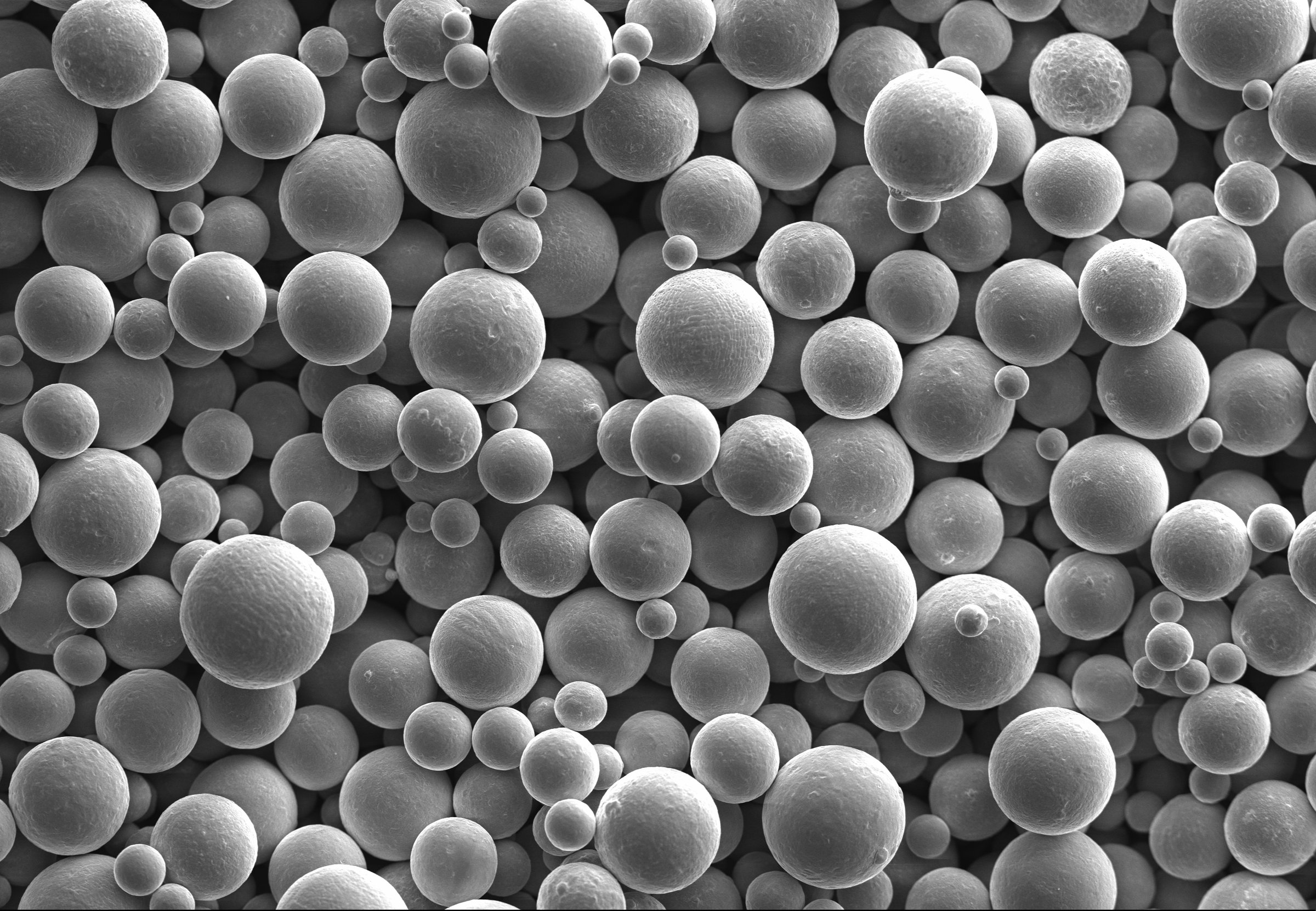
Powder characteristics for LPBF
LPBF powder selection starts with the characteristics that influence powder spreading, packing behavior, and process stability. Metalpine supports LPBF programs with powders engineered for demanding additive manufacturing (AM) requirements and documented for batch-to-batch consistency.
Families that qualify for LPBF
Close particle size distribution and high packing density are important for common LPBF systems, regardless of machine manufacturer. Metalpine supports LPBF projects with powder production and refinement, screening, classifying, packaging, and laboratory services for material families commonly used in laser powder bed fusion.
| Material group | Grades |
|---|---|
| Copper | CuCr1Zr, CuNi2SiCr, Cu-OF, CuNi30 |
| Iron and Stainless | 316L |
| Nickel Superalloys | IN718, IN625 |
| Titanium | Grade 5 (Ti-6Al-4V), Grade 23 (ELI), CP Titanium |
| Refractory metals | MET Mo 99%, MET Nb 99%, MET W 99% |
| Special alloys | Custom chemical composition on request |
Why powder quality matters in laser powder bed fusion
In LPBF, powder quality directly affects layer uniformity, packing density, and process repeatability. Powders with high sphericity and controlled flow behavior help support even recoating and reproducible results across development, qualification, and serial production.
Metalpine designs its wire-based gas atomization process to produce highly spherical, 0% porosity powders with strong batch-to-batch consistency. Low-satellite powder fractions are especially relevant for LPBF because they support smoother powder spreading and more predictable behavior during printing.
Because LPBF requirements vary by component geometry, machine settings, and application targets, powder selection should match the intended process. Metalpine supports this with toll processing for individual powders, including production and refinement, screening, classifying, packaging, and laboratory testing for project-specific powder specifications.
The Art of Spherical Powder
Metalpine’s proprietary wire-based gas atomization process produces highly spherical metal powders under argon in a controlled production environment. A careful focus on purity, powder morphology, and repeatable processing supports AM projects where documentation and consistent powder behavior matter.
Production runs under argon, with oxygen-free handling options available for selected requirements. Metalpine also operates a back-up powder manufacturing location at its R&D site in Niklasdorf, 75 km from Graz. Its quality management system is certified to ISO 9001 and EN 9100 for R&D and serial production.
Quality, testing, and documentation
LPBF programs often require documented powder characteristics before qualification and production. Metalpine’s in-house laboratory supports this with measurement and testing services for key powder properties, including:
- Particle size distribution with sieve analysis (on request).
- Dynamic image analysis according to ISO 13322-2.
- Laser diffraction according to ASTM B822 (on request).
- Flowability testing according to ASTM B213.
- Apparent density according to ASTM B212 and tap density on request.
- Chemical composition testing.
These services help teams evaluate whether a powder matches the requirements of their LPBF system and process window. Binding batch values are recorded in the test certificate, supporting qualification and documentation workflows.
Questions about powders for laser powder bed fusion
Why are sphericity and flowability so important for LPBF?
LPBF depends on uniform powder layers. Spherical particles and controlled flow behavior help support even spreading, stable recoating, and reproducible results.
Which particle size fractions are typical for LPBF?
Standard LPBF fractions are 15–45, 15–53 and 20–63 µm; other fractions within the 10–90 µm range are available on request, depending on the application and process requirements.
Can Metalpine support different LPBF systems?
Yes. Metalpine can tailor powders to common LPBF systems and hardware-independent requirements.
Which material families are available for LPBF?
Metalpine offers copper, iron, stainless steel, nickel superalloys, titanium, and refractory metals for LPBF applications. Custom alloys are available on request.
How are powder properties documented?
Metalpine documents relevant batch-specific values in the test certificate and supports qualification with in-house laboratory testing.
What are the requirements of your LPBF process?
We’re happy to assist you in selecting the powder properties that best fit your system and processing method. Tell us the material group, target fraction, and documentation requirements you need, and we will review the options with you.