



Refractory metal powders – molybdenum, niobium, tungsten
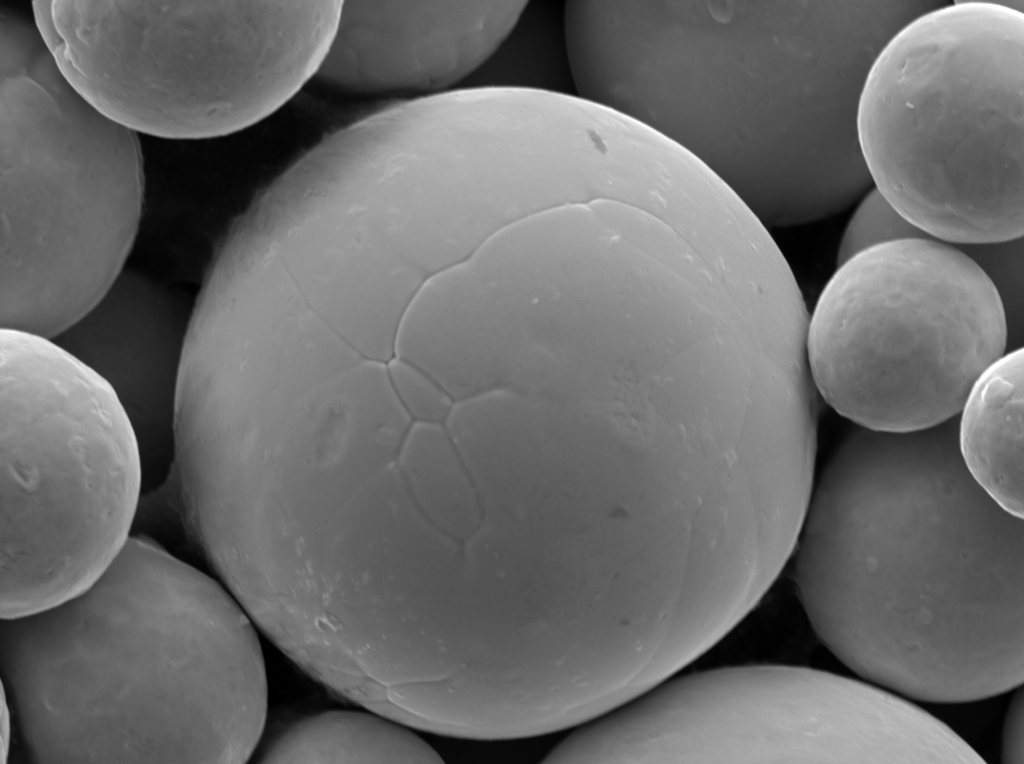
Molybdenum powder, niobium powder and tungsten powder for highly demanding applications, processed by additive manufacturing (AM / 3D printing), metal injection molding (MIM) or other technologies. Our proprietary wire-based gas atomization process produces highly spherical, 0% porosity powders from these high-melting-point refractory metals.
Find your powder
Which powder fits your application?
Particle size (µm)
Typical for
Standard fractions from our portfolio; other particle size distributions on request.
I work in
using
and need
for
Choose an option to see matching powders.
Available grades and processes
These standard grades are supplied for laser powder bed fusion (LPBF), directed energy deposition (DED), electron beam melting (EBM), and metal injection molding (MIM), regardless of machine manufacturer.
- Mo 99% Datasheet for MET MoPDF
- Nb 99% Datasheet for MET NbPDF
- W 99%
- LPBF
- 15–45 µm
- 15–53 µm
- 20–63 µm
- DED
- 15–53 µm
- 45–106 µm
- EBM
- 45–106 µm
- MIM
- 5–25 µm
| Element | Min [wt%] | Max [wt%] | Remark |
|---|---|---|---|
| Mo | 99 | — |
Available fractions are 15–45, 15–53 and 20–63 µm for LPBF, 15–53 and 45–106 µm for DED, 45–106 µm for EBM and 5–25 µm for MIM. Binding values for each batch are stated in its test certificate.
Documented for every batch
Each batch is tested for the properties listed here, and the results are recorded in its test certificate. Our in-house laboratory measures particle size distribution (PSD) by dynamic image analysis; laser diffraction is available on request. A sample certificate based on previous production campaigns is available on request.
| PSD D10/D50/D90 | per batch |
|---|---|
| Sphericity SPHT3 | per batch |
| Flowability | per batch |
| Apparent density | per batch |
| Chemical composition | per batch |
Industries
Refractory metals are generally defined as metals that melt above 2,000 °C. Molybdenum melts at 2,623 °C, niobium at 2,477 °C and tungsten at 3,422 °C. These are used for components that operate at very high temperatures, typically in vacuum or protective atmospheres. In conventional fabrication, the limited availability of bar, plate, and sheet stock restricts the shapes that can be made. Additive manufacturing builds components directly from powder and reduces these design constraints.
Questions about refractory metal powders
What do “highly spherical” and “0% porosity” mean?
We define “highly spherical” as a sphericity above 0.90, where a value of 1 corresponds to a perfect sphere. 0% porosity means dense particles with no pores within the powder particles. Spherical particles flow and spread well, which supports dense powder layers in the powder bed of the LPBF process.
Why does oxygen content matter for refractory metal powders?
Refractory metals have a high affinity for oxygen at elevated temperatures. In pure molybdenum parts built by LPBF, oxygen segregates to the grain boundaries during solidification and weakens them. To limit oxygen pickup, we atomize with argon and can also classify, screen, and pack the powder under argon. Oxygen and nitrogen content is documented for every batch.
Can you supply other refractory metals or custom compositions?
Yes. Our proprietary wire-based gas atomizing process can atomize almost any metal or alloy to customer requirements, so refractory metals and alloys beyond the standard grades are available on request. We agree on nonstandard powder specification and chemical compositions with you before the first batch.
What lead times can I expect?
Powder in stock is ready to ship in approximately 3–5 business days. For new production, the lead time is usually 3–12 weeks. It depends on our current order backlog and on confirmation from our raw material supplier. Contact us for a confirmed lead time for your order.
Are refractory metal powders subject to export controls?
Yes. They are dual-use goods, so exports from the EU are subject to a European and / or Austrian export license requirement. A license requirement can also result from the final destination or the intended use. As a rule, we need a completed end-user certificate (EUC) with every order and for each material, although exceptions can be evaluated.
How is the powder packed and delivered?
Standard packaging units are 5, 10, and 20 kg, and we supply units from 100 g up to approximately 500 kg. On request, we can pack powder under argon or in custom packaging. Our standard delivery term is FCA (Free Carrier). We can also deliver DAP (Delivered at Place) and arrange transport to your location.
Is your quality management system certified?
Yes. It is certified to ISO 9001 and to EN 9100 for R&D and serial production, the quality management standard for aviation, space, and defense organizations. EN 9100 is technically equivalent to AS9100. Both certifications apply to our quality management system, not to individual powders or the components made from them.
Request a sample or datasheet – Refractory Metals
Tell us the grade, process, particle size fraction, and quantity you need. We will review your requirements and confirm availability and lead time.